De Librije - Making Epicures of Us All
De Librije is a 3 michelin star restaurant in Zwolle, about an hour and a half train ride away from Amsterdam. Opened in 1993, it’s been awarded 3 michelin stars every year since 2004; it is considered a premier fine dining spot both in the Netherlands and Worldwide. Focusing on modern dutch cuisine, De Librije pairs ingredients sourced from the Netherlands (that are usually sourced elsewhere) with other global ingredients. It uses some “French”/ General European Fine Dining technique, and even some modernist approaches to effect unique flavor pairings and dishes centered around articulating the precise nuances of their underlying components by sometimes contrasting flavors and sometimes, more interestingly, positing two broadly similar tastes to help the diner discern the exact timbre of the overarching flavor latent in the individual constituents of the plate. For me, simply put, it’s one of the best meals I’ve ever had the pleasure of experiencing. The flavors and textures are varied, clever, and outstanding. But most importantly, the way the compositions guided me through discerning and analyzing their elements made me feel like I had the palate of a talented chef, though I’m obviously very far from it. I cannot recommend this meal enough. My specific impression of each dish is as follows:
1. Three Amuse Bouche from their "Passport of Ingredients"
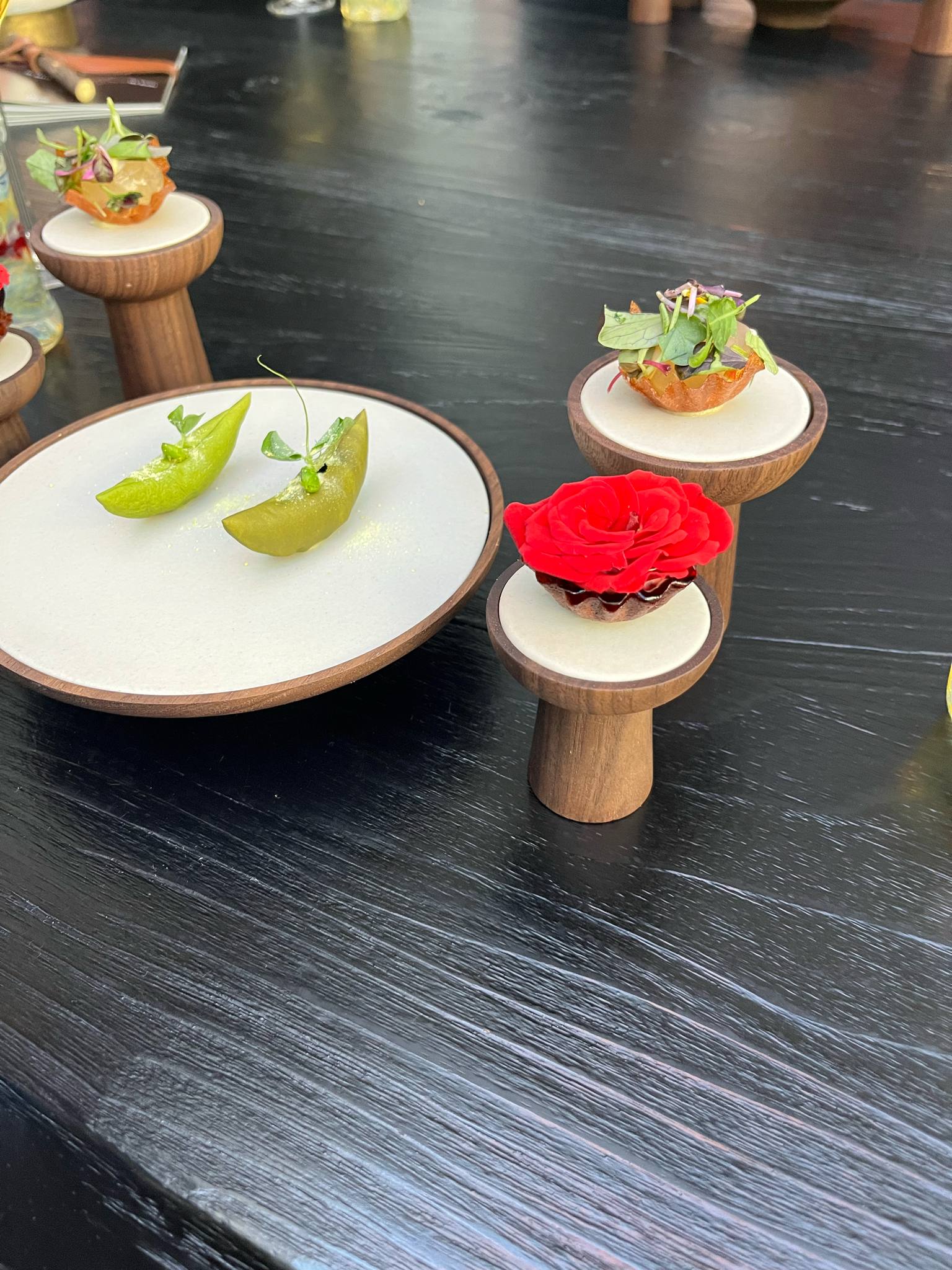
The first dish comprised of three small bites, a common prelude to the procession of the more substantial dishes. In this case, they use these 3 dishes to highlight their “passport” of flavor. It highlights exactly where their various ingredients come from throughout the menu, many of which are from the Netherlands. This is a dish to exemplify their fidelity to Dutch cuisine and technique by using unique ingredients from the Netherlands.
Bean with Horseradish Sauce
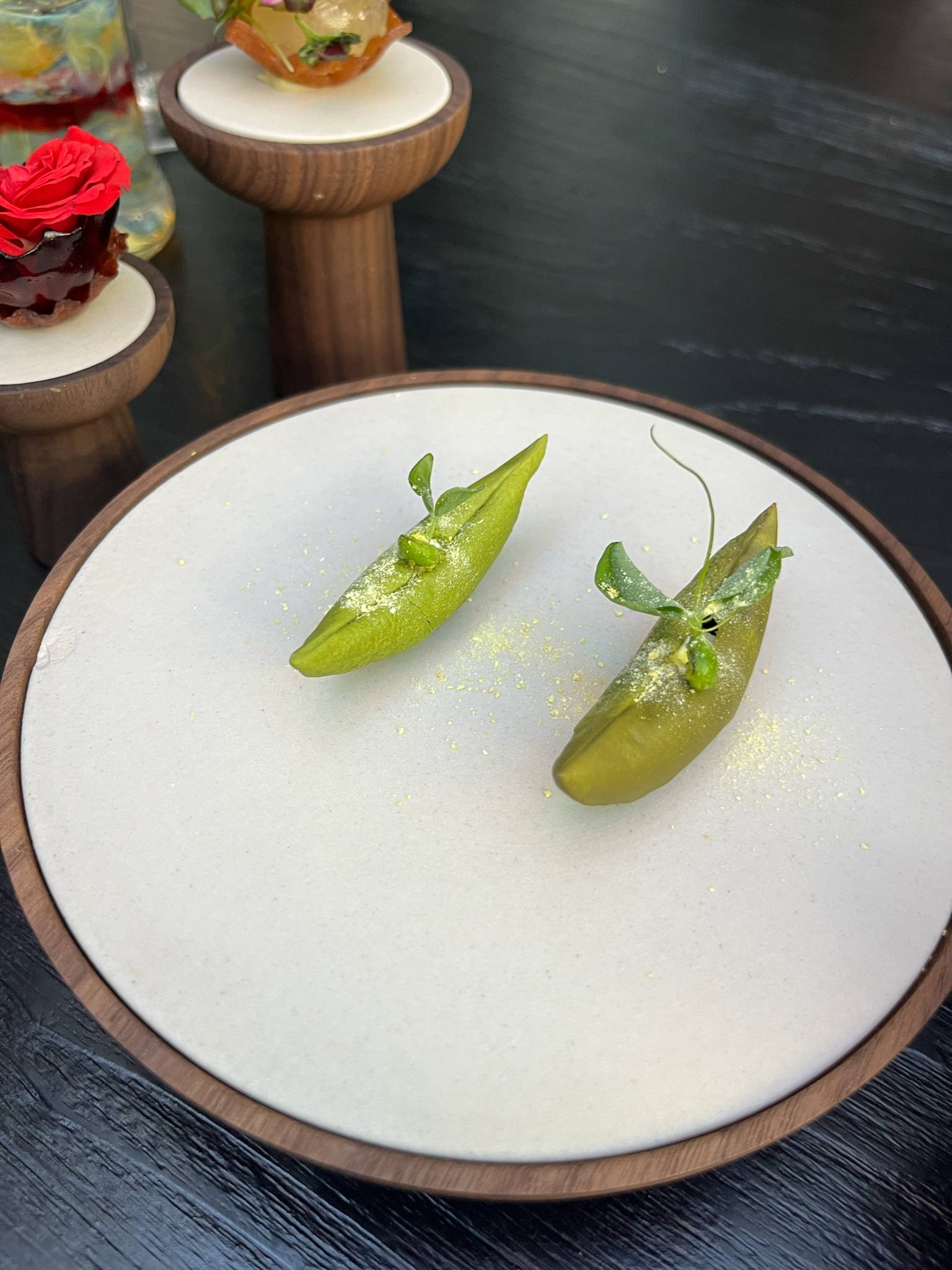
The bean was quite mustardy and biting as expected which is a great way to start a meal for me, a lover of wasabi. It was a little earthy as expected. Interestingly the flavor was almost a little like a cakey lemon cookie.
Tartlet with lemon verbena and kohlrabi
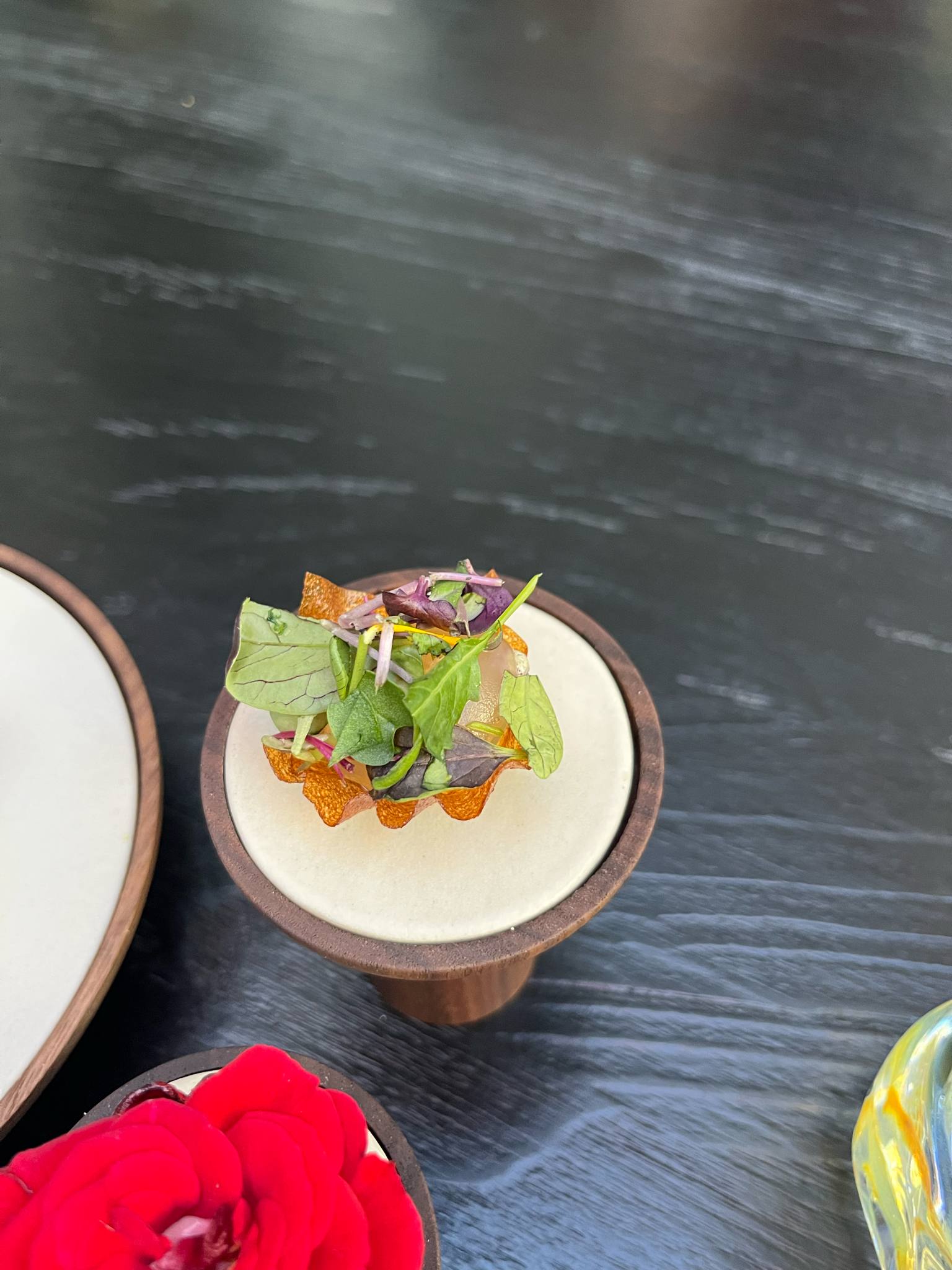
The tartlet shell was super crispy and light. The entire bite was fresh and fragrant. It was juicy and a little grassy from the kohlrabi.
Rose with Beet and Lovage
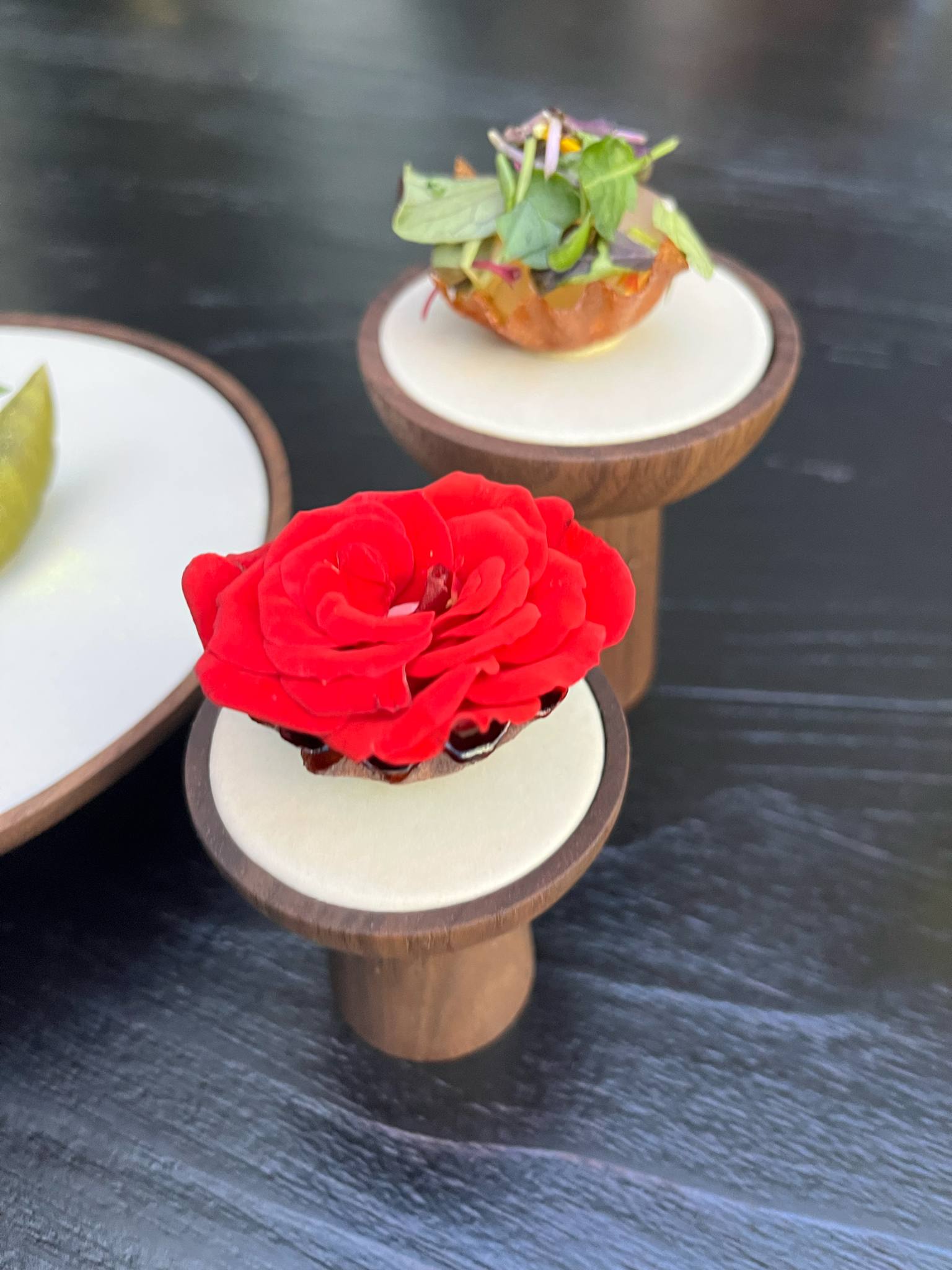
This was by far the best of the 3 amuse bouches. Accompanying the rose water florality was a kick from the pepper on top which was quickly mollified by the mascarpone/mayo hybrid cream on the inside that added a little sweetness and a lot of fat to round out the earthy and spicy (by fine dining standards) beet and lovage.
2. Three more substantial amuse-bouche
The next dish was another triplet of small bites, each being a little larger than the previous trio, and having a little more substance to them.
Utrecht Oyster Smoked with a Pickle Sauce
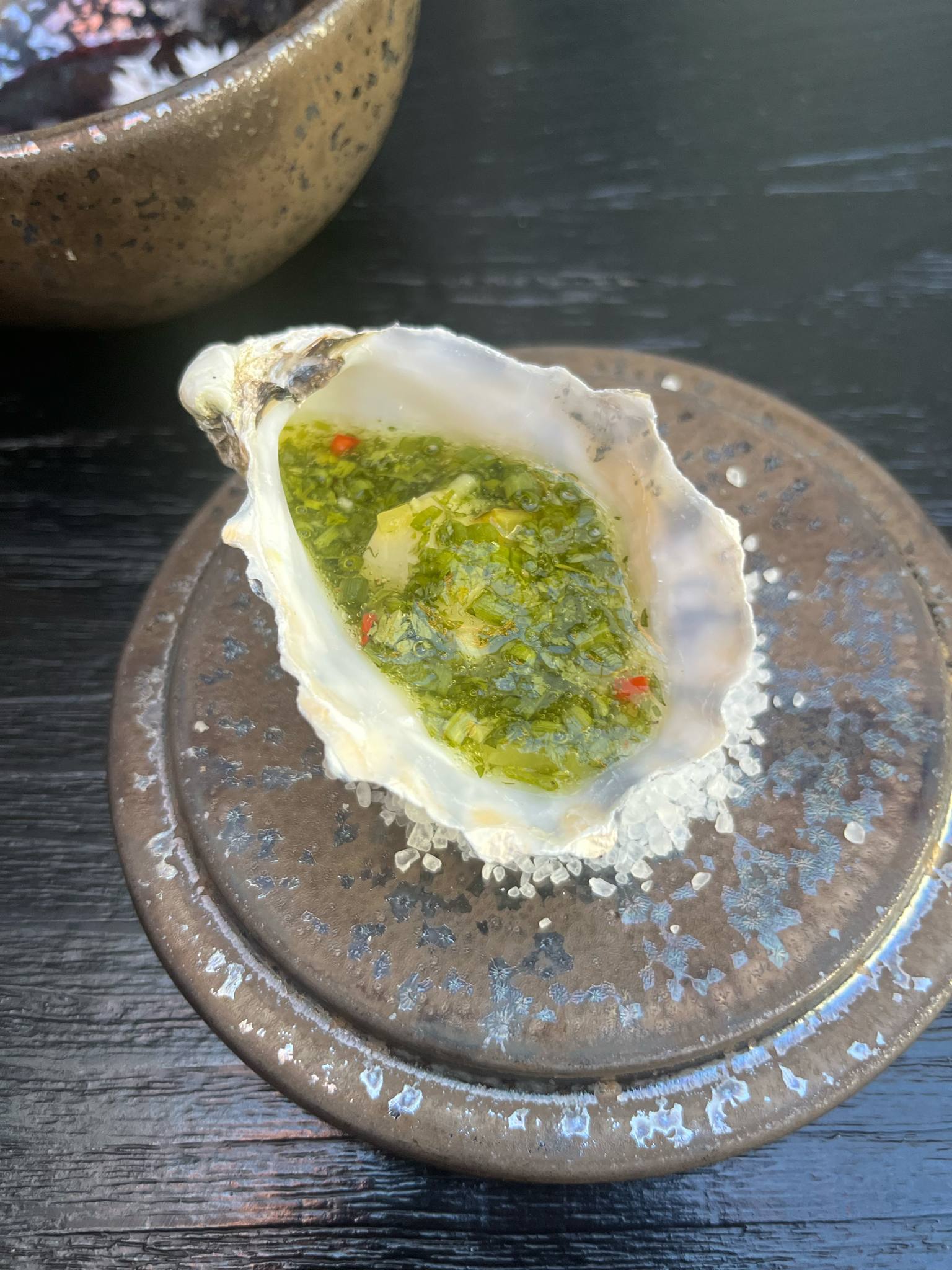
The dish was not as smoky as I’d anticipated. But the oyster is outstanding. It balances that briney sea breeze flavor and the creaminess of Northern European oysters. For me, those more creamy, and usually smaller oysters are more appealing to me. They feel more balanced compared to the purely salty, ocean tasting oysters with immense minerality that finish like you’re tasting a penny (in a good way sometimes). Instead these are silky, salty, and finish with a more “stoney” mineral taste as opposed to a metallic one. This was especially a great pairing in this case with an extremely sour pickle sauce that was a little like a non-spicy hunanese pickle you’d get with fried pork. It’s a little less like a super intense cucumber pickle juice and more like a fermenty/asian pickle like flavor. I’d maybe contend that it was a little too sour, but in all fairness, I was only 1 week detached from a night inundated with pickle back shots, so forgive my slight negative bias.
Madras Curry Smelt Pocket
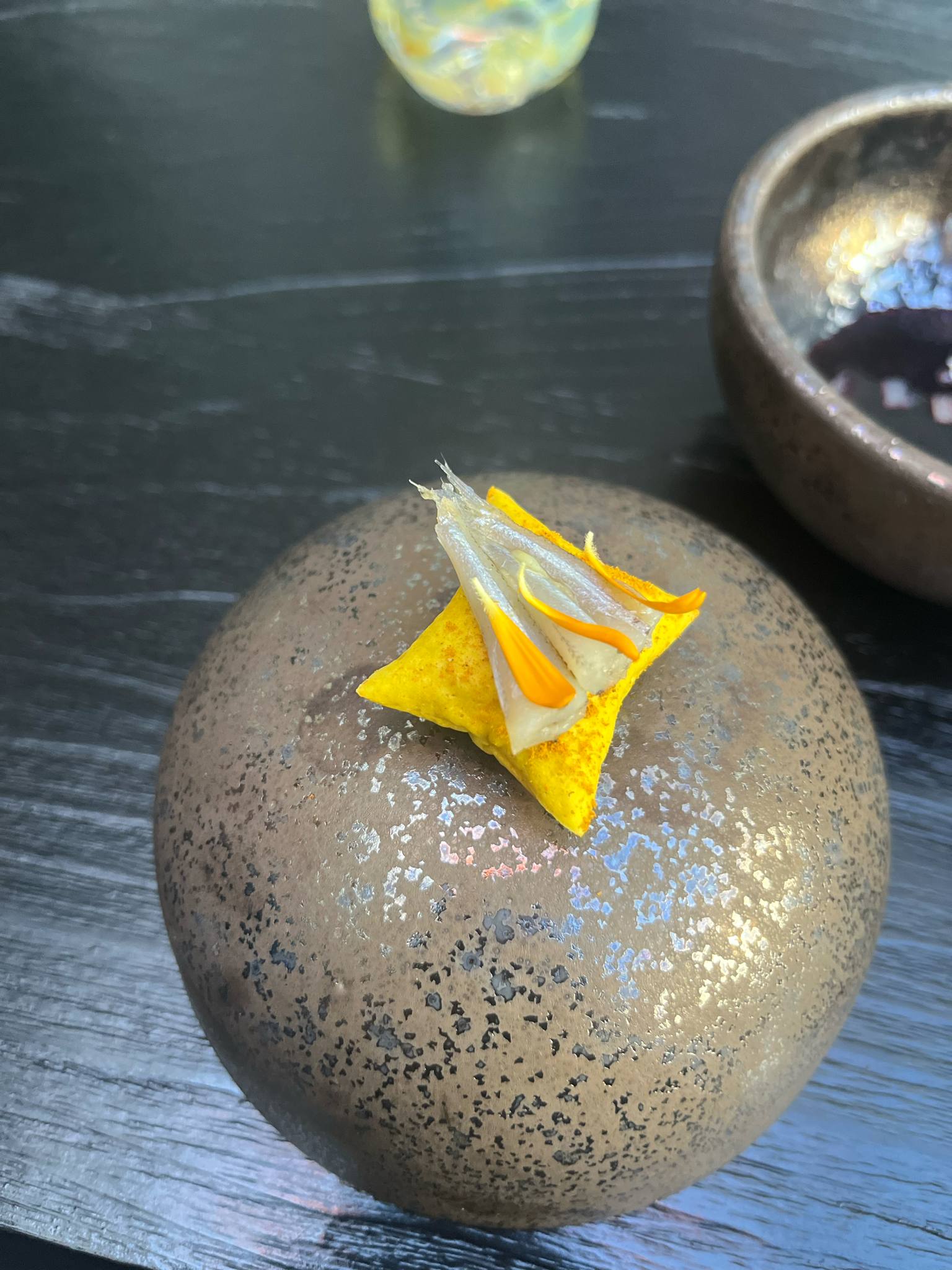
This was a fresh, small piece of smelt on top of a semi-pliable pastry pocket that housed a madras curry inspired powder. I’ll note, the pastry itself was a little too chewy and dry for me. It wasn’t bad, but was maybe 10% too chewy and 5% too dry (or some other 2 arbitrary percentages too chewy and dry). The issue there is it makes the exterior taste a little stale despite it obviously not being old. The dish itself was a flavor bomb. It was like a burst of garam masala (essentially curry powder) suffused with a slight coconut cream motif. The fish itself was the unsurprising star. It was supple and then immediately soft and tender after the first bite. Its taste was most close to a sardine with a more delicate fishy taste as opposed to an overwhelming punch of umami. Indeed, because of that delicate fishiness, the umami was in perfect harmony with the curry flavor as opposed to overpowering. I do wonder how this would have tasted with the smelt inside the little pocket, though I feel perhaps even if it would be a little better, the added effort would almost certainly not be worth it.
Cabbage Tea with Mustard Greens and Mustard Seeds
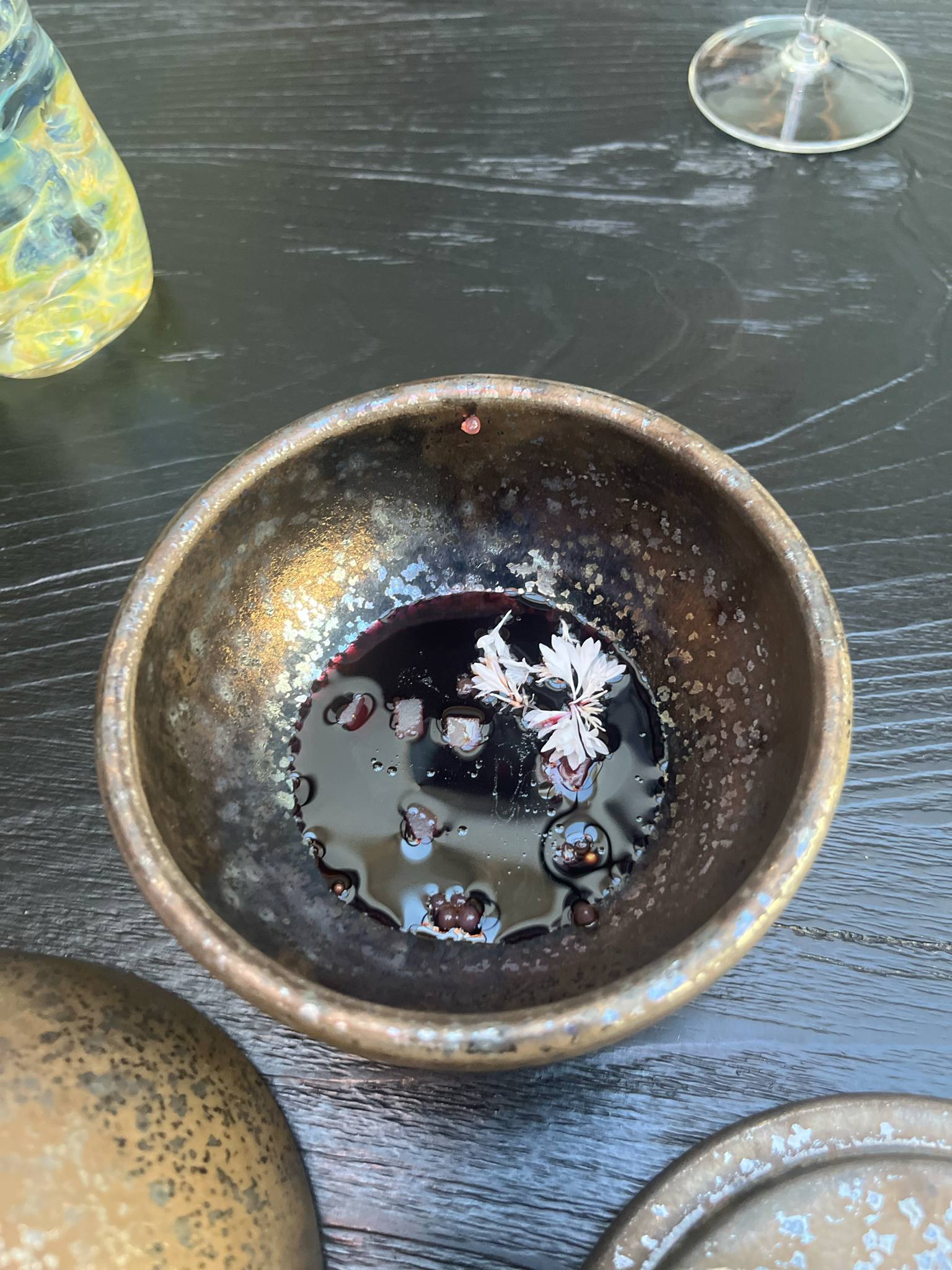
Surprisingly, up to this point in the menu, this was my favorite “impression”... a term maybe too pretentious even for me. The dish itself though was very much a cabbage infusion with mustard greens inside. The tea was a little like viscous like a diluted syrup and was sweet like honey. The vegetal cabbage helps balance the dish, preventing it from veering into cloying territory. No doubt, it does a very good job of playing that mediator role. Though the mustard greens and seeds do a lot to assist the cabbage’s role here. The dish is a unique articulation of the sweet elements of cabbage that still maintain its core as a peppery and vegetal crucifer.
3. Buckwheat Pancake with Sour Cream Foam and lots of Caviar Accompanied with Grated Cured Egg Yolk on top
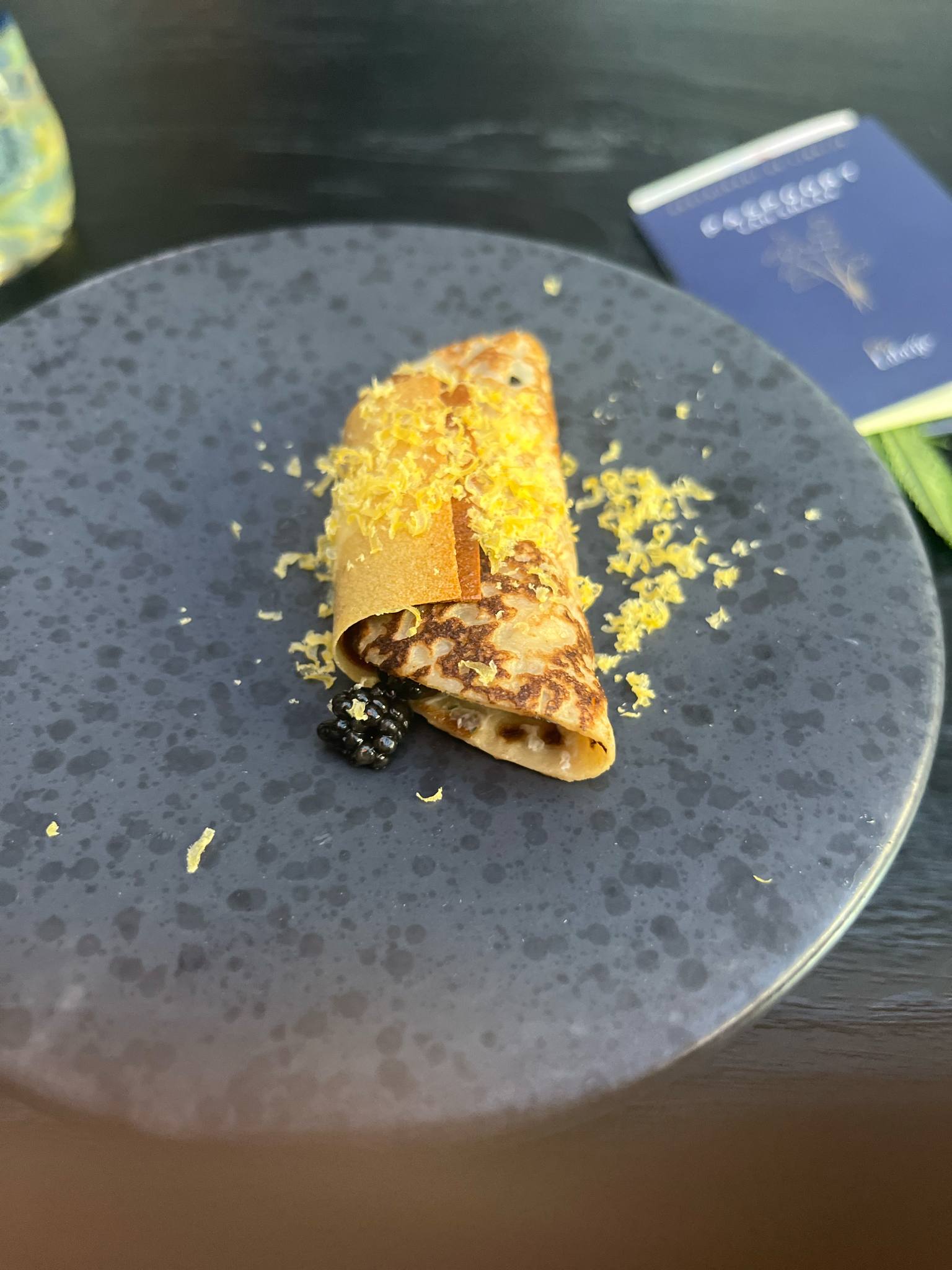
In front of us, 2 chefs from the restaurant make Buckwheat pancakes, an ode to the famous poffertjes of the Netherlands (think dutch flapjack). They continue by spooning copious caviar and sour cream foam into the center of it. Lastly, they compose it to look like a mini taco and then grate cured egg yolk on top of it. Everyone in our party of 4 liked this dish but it was nonetheless the most divisive compared to any other plate in the over 4 hour meal. We all agreed it was tasty because the caviar was delicious, buttery, oceanic, and had a delightful woody finish. Furthermore, the sour cream was a nice addition as a tart pairing to the creamy and salty caviar. These flavors were enclosed in a texturally perfect mini pancake, whose boundary had a crisp that provided a subtle but important variation from the luxurious interior. However, for me, there was a surplus of the sour cream foam and the pancake lacked some sweetness I both expected and hoped for. It would have added an extra nuance to the dish that balances the other flavors, but more importantly would have established the dish as one that uses a Dutch classic’s inherent flavor as an original expression of the archetypal caviar and creme fraiche pairing. Essentially, the fact that it was just a vehicle for good caviar, not notably different from blinis, made this dish a little uninteresting for me. I think if there was that sweetness from usual poffertjes, then we could’ve seen whether it helps articulate caviar and cream in a better and more exciting way than the dyad’s usual presentation. That said, my two friends across from me told me they had a heavy dose of sweetness from the pancake and said they actually only had a hint of the sour cream foam. It seems, the variability of this dish will really come down to who is making it for you as they had another chef making theirs. For ours, he potentially cooked the pancake too long or more likely, added so much of the sour cream foam, that the dulcet notes of the ideal pofferjtet were drowned out. I wish I had the version they did, but I do also wish they just didn’t use this type of gimmick. It’s exciting for a moment, but feels like it allows too much variance in quality. Maybe I’m alone on that, and maybe that specific experience is uncommon, but those are my impressions. That said, as noted above, it was still delicious… I mean who hates good caviar and sour cream on a pancake?
4. Brown Shrimp with Fois Gras and a Sauce Made from the Brown Shrimp Heads and Some Tomato Drops (?) + a Brioche Bun
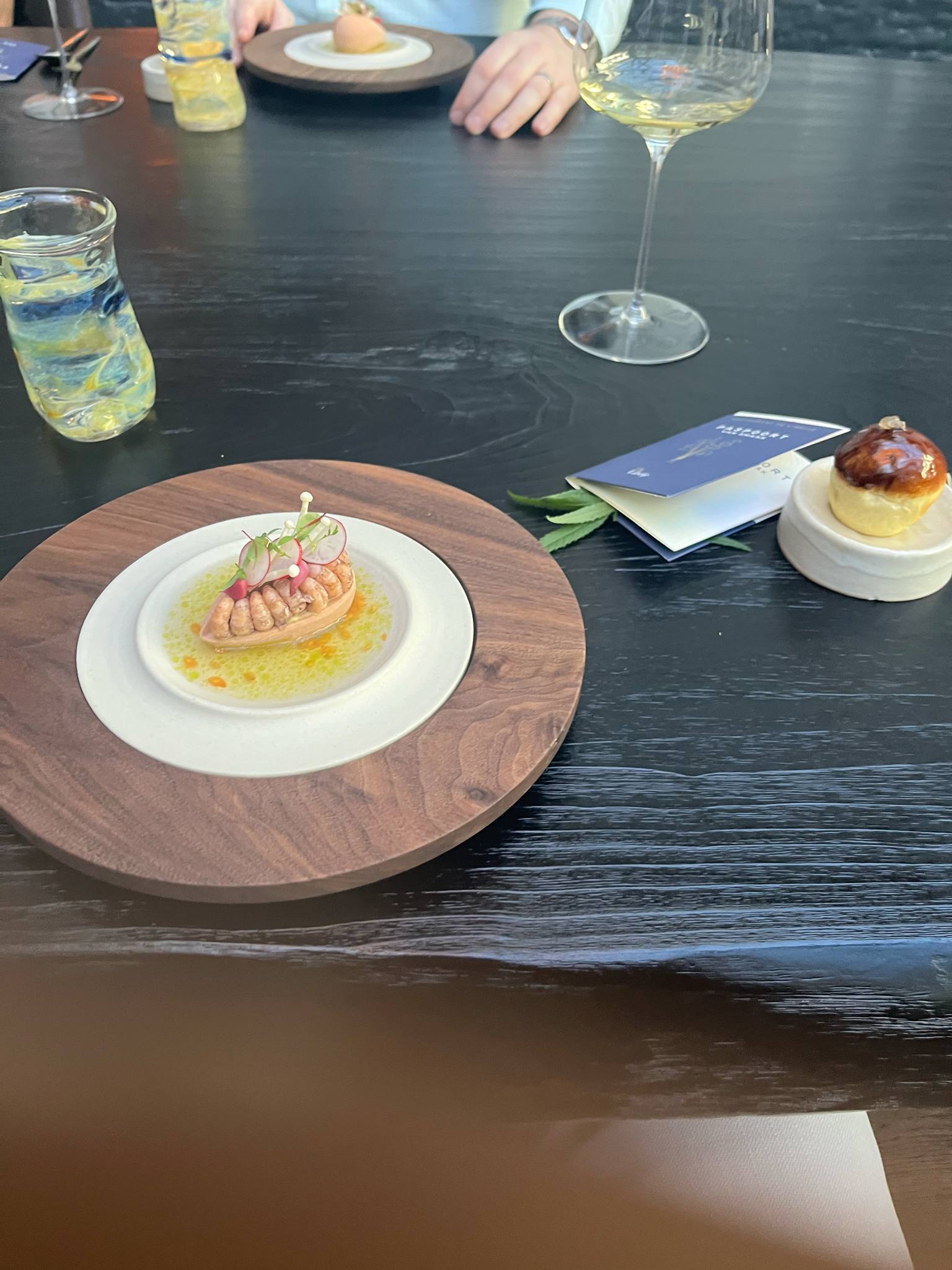
A meticulous, linear arrangement of small shrimp adorns a considerable portion of foie gras on top of a thin half oil/half stock sauce suffused with the flavor from the heads of the brown shrimp mixed with dots of tomato water (I believe). First, I’ll note, I love foie gras. It’s one of my favorite things in the world, and if we’re not counting Sushi and Community (the TV Show), it might literally be my favorite thing. This foie gras specifically is the platonic ideal of the ingredient. It’s unctuous, meaty, a little funky, and a little grassy. I personally love the more spreadable and soft foie gras, like the one here, especially since it feels like it better maintains the various nuances of the ingredient. I kind of think of a good foie gras as a meaty camembert. Both of these goods are characterized by their earthy, rustic, and mature, developed flavors that even veer into musty territory. With that said, a good foie gras is not impressive on its own other than being a testament to outstanding sourcing. In all fairness, sourcing is a talent that can’t be understated. Some of the best restaurants are amazing almost entirely because of their facility with the acquisition of top ingredients. But I wouldn’t have been as excited by this dish without the actual key component of the dish, the shrimp. The brown shrimp are sourced from the Netherlands, but in general can also be found in the Northwest Atlantic waters near Massachusetts and even in the Gulf coast. While sweet like most well sourced shrimp, brown shrimp tend to be more salty and carry a slight metallic mineral flavor (sometimes referred to as iodine tasting). They are far more robust than something like white shrimp or even Carabineros from Spain, which while very flavorful are sweet and a little delicate like Lobster. In this case and for that reason, they make an ideal pairing with foie gras. These shrimp are smaller but still meaty with a tacky exterior and toothsome core. That meaty bite gives some textural contrast to the creamy foie gras, but more importantly gives each component’s flavor time to materialize. That is to say, when I ate a bite with foie gras and the shrimp together, some of the foie gras coated the shrimp, some coated my mouth with a sheen of that deeply flavored meat butter, and some just dissolved on the tongue establishing a wave of that earthy flavor. But then, as I continued to bite into the shrimp, that canvas of meaty funk was inscribed, first by the bright sweetness from the shrimp, and then by its metallic mineraly finish, all the while being accented by the sauce coating the shrimp which is embedded with a darker, deeper sweetness derived from the caramelized heads, and a counterbalancing acidity from the traces of tomato in the sauce. Pairing something sweet with foie gras, like a jam or honey is not uncommon at all and is very delicious because it helps highlight the funkier overtones of foie gras while also giving a smoother epilogue to the overwhelming ingredient by cutting any bitterness from the grassy aftertaste. But in this case, that sweetness was unique as it came from the brown shrimp which first plays the role of the jam/honey then combines with the slightly metallic aftertaste of the foie gras and in the process, bolsters its own minerality and salty umami. The dish pairs two ingredients to first encapsulate a classic flavor combination as the base of the dish and then creates a sumptuous painting of flavors that both accentuates its individual components’ specific flavors and synergizes them into a blast of funk, sweetness, and a multivalent metallic minerality I’ve never tasted before or since. I’ll quickly finish by saying that the brioche was great, buttery, and provided a great vehicle for the leftover foie gras and sauce.
5. Langoustine with a Red Vanilla Sauce
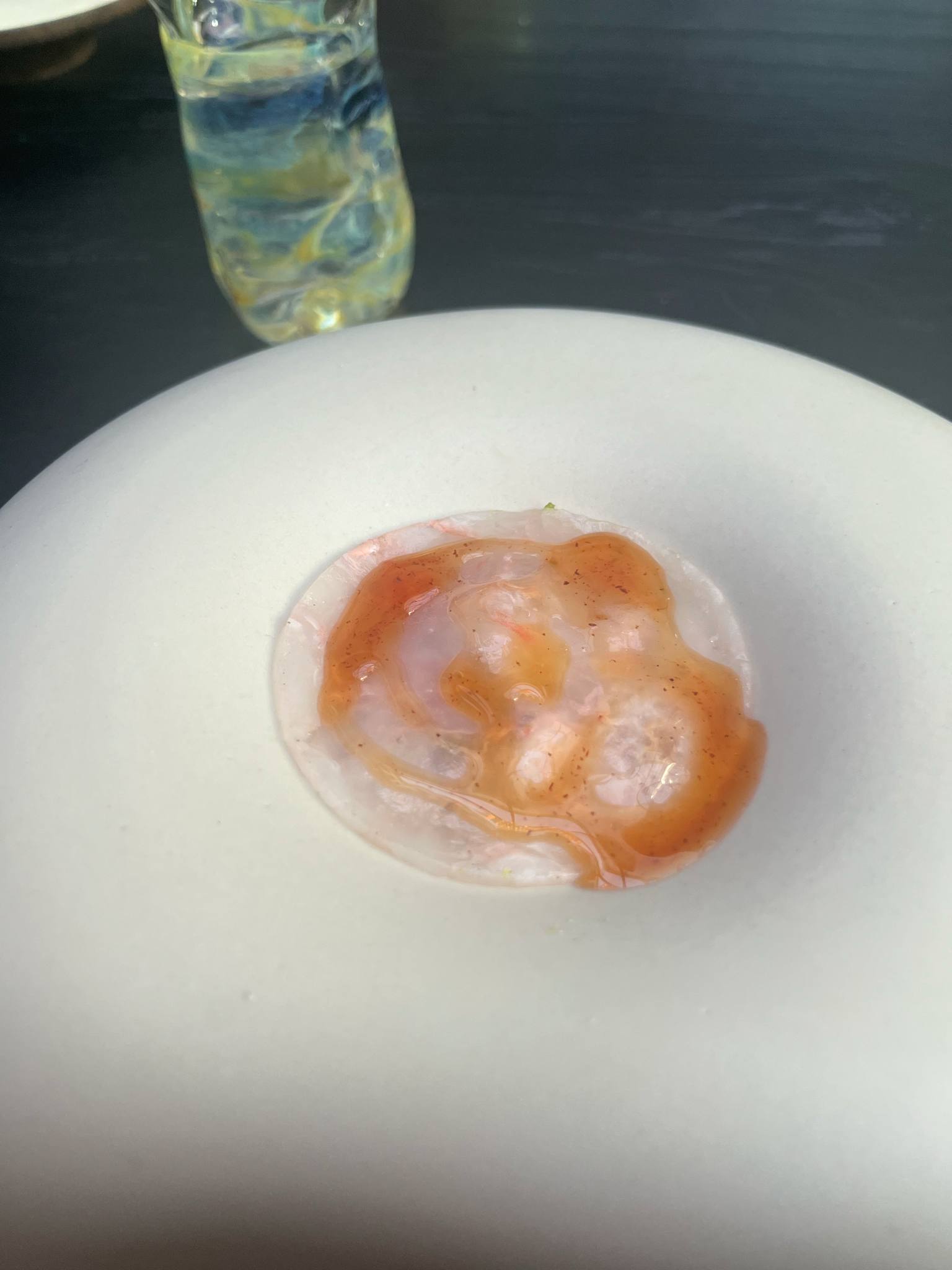
A thin “blanket” fashioned from langoustine dressed some chunks of langoustine. The two forms of langoustine were both on top of and layered underneath a sauce/oil made from the langoustine and red vanilla. At the restaurant the server gave a long prologue on the red vanilla, both showing us the original vanilla bean- which was in fact very red- and then describing its origin. They funnily enough noted that they grow it personally in an undisclosed part of the Netherlands. Why that secrecy should play a role in the dish is unclear to me but for what its worth, its a fun anecdote that added a cool context to the dish. On the actual value of this coveted and hidden red vanilla, they noted that it is a much more concentrated vanilla flavor. I can at least attest to that because this dish was my favorite one up till this point, even usurping the previous foie gras and brown shrimp plate, a feat I thought would be impossible. Boy, would I find out how mistaken I was. I’ve never been so happy to be proven wrong. While the “langoustine blanket” was visually interesting, its only main addition was being a unique texture of langoustine. But that said, I think that variation was intriguing, albeit a little superfluous. Nevertheless, the flavor paired with the Langoustine was ethereal. The sauce had a peppery element that complimented the concentrated vanilla. The sauce was bursting with a floral sweetness that I’ve never tasted before. It was a paradox of delicate and intense flavors varying between more of an aromatic aura of a woody, perfumed sugariness and a robust creamy, caramel sweetness. Somehow, there were elements of earth and fruit in the sauce’s composition. However, of note, the sauce was more of a thin oil which coated and only slightly penetrated the langoustine, which made those creamy notes all the more fascinating. The langoustine itself was outstanding. Both the sheet and the actual chunks were tacky, juicy, and full of that delicate crustacean sweetness that makes Langoustine my favorite crustacean/shellfish to eat. It’s the best of both worlds between Lobster and Shrimp as it is meaty, delicate, sweet, and flavorful whereas shrimp is less fatty and lobster is less flavorful. This floral, woody sweet serape draped the langoustine and combined to create a fortified panoply of fragile flavors that bounced around my mouth as I bit into the turgid meat. An amazing attribute of the dish was that because the sauce was more of an oil, its aroma and flavor stayed in my mouth as I continued to eat, providing a gradient of the langoustine’s flavor to the distinctive vanilla over time. On that point, this is a good example of where when two ingredients have the same underlying flavor (sweetness), the minutiae of each component’s base flavor can be better exemplified by combining them in an original way that allows the eater to recognize the specific forms of that flavor. That is to say, the langoustine’s sweetness helps elucidate the woody elements of the vanilla while the vanilla’s more overbearing, saccharine nature illuminates the langoustine’s umami notes in its own expression of sweetness. For me, as much as I love langoustine, it’s tough for me to note its umami usually, but this dish gave me a new appreciation for my favorite crustacean. The last thing I’ll say about this dish is that it’s more clear why this specific vanilla is needed. If I had to guess, I’d say it would be tough to create an oil-like sauce that carries such a substantial flavor without the vanilla being so concentrated. Otherwise, the vanilla might fall away, or an entire thicker sauce would be needed which might have overwhelmed the langoustine.
6. Pumpkin and Pickles in a Choux Pastry with Cheese from Zwolle
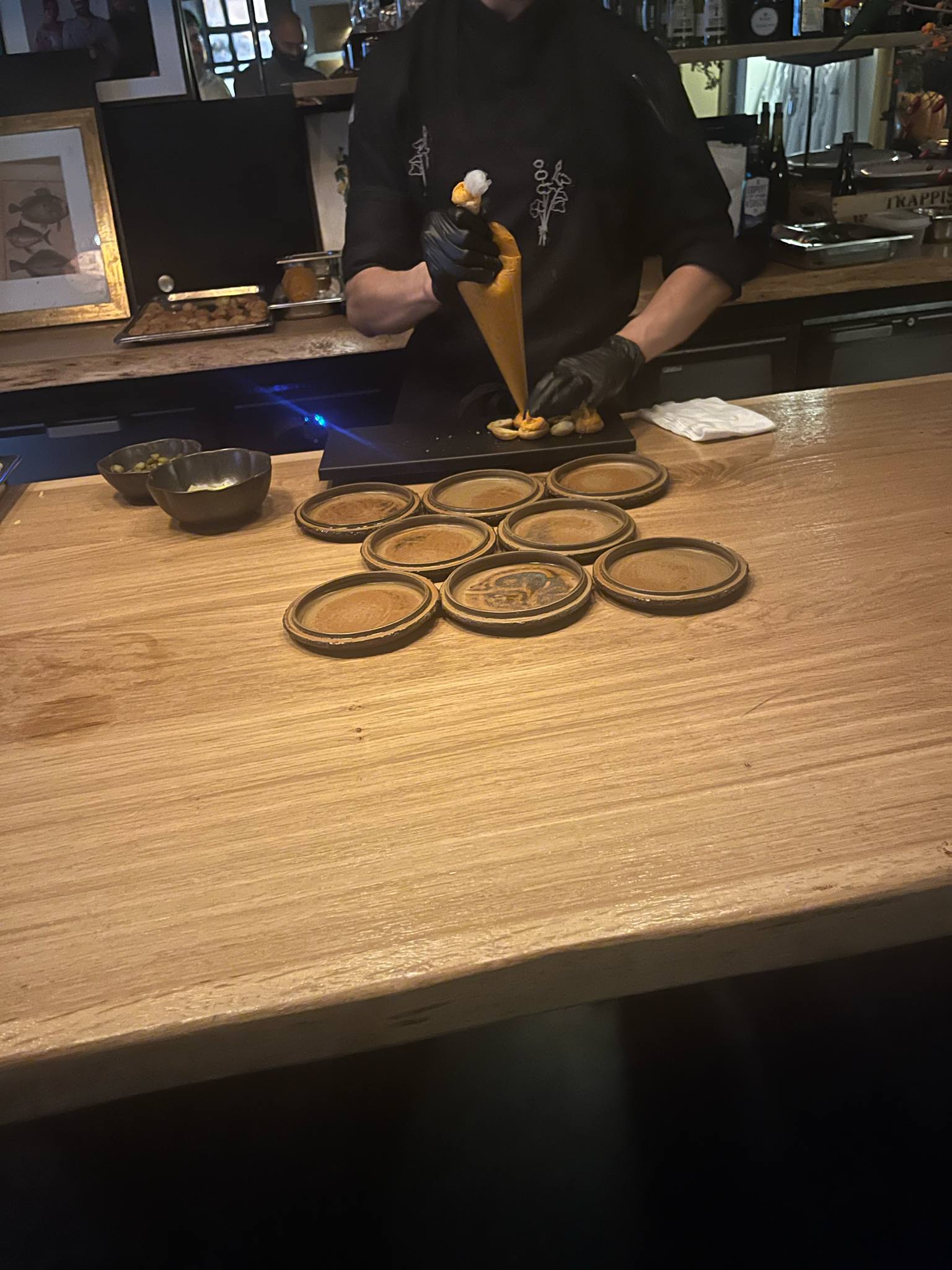
At this point we were taken inside to see a quick tour of the establishment, during which we were shown the preparation of this quick bite. The dish was delicious, the pastry was puffy and had a great crunch that transformed into a fluffy and soft bite while the cheese was very savory and a little sweet. I especially loved the pickly element of the dish that made the dish sweet, sour, and savory. It was a quick and nice detour before the rest of the meal.
7. Seed roll with Goat Milk Butter made with some Dutch Berry Juice as well-
(Forgot to take a picture) The seed roll was a solid piece of bread, nothing too exciting. The butter itself was great, it was a little tart and a little more fermenty like a cultured butter. What was cool was that it tasted a little like ghee (clarified butter) as well.
8. Weaver Fish with Macadamia Nuts, a Green Pepper and Jalapeno Foam, and with Seaweed
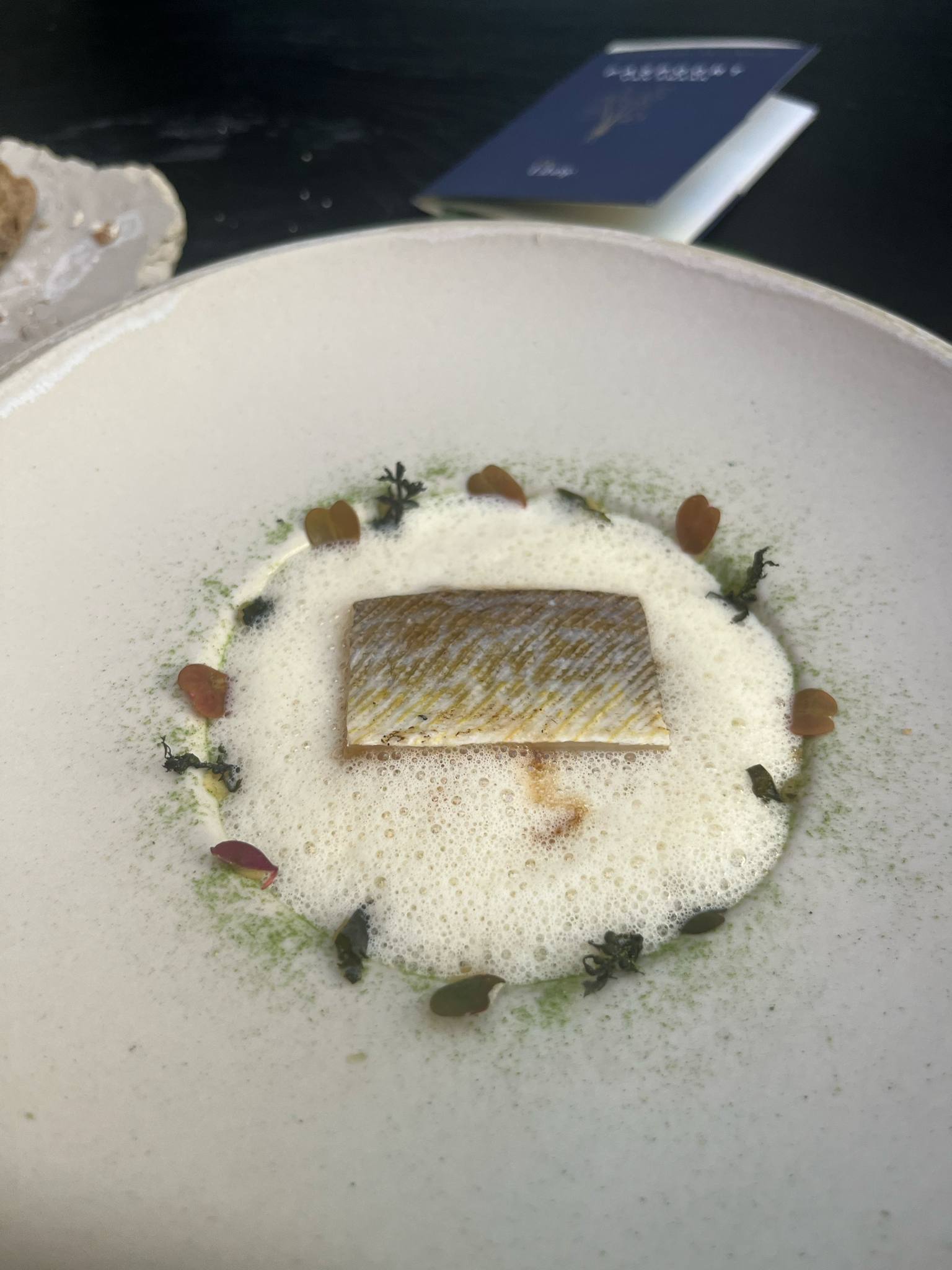
The weaver fish here was cooked in that butter mentioned above. The fish itself was perfect from a technical perspective. It was the ideal consistency to accept the flavors from the foam. It was smooth, oily, and fatty, but still was cooked through to add just the slightest chew. That said, for me, the fish itself was a little bland, but that was fine because the foam was delectable. It embodied the very vegetal, peppery elements of green peppers and jalapeno. There was a pleasant, spicy kick which helped flavor the fish. Because its a foam, that kick disappeared as quickly as it presented itself leaving just the slightly sweet elements of the peppers for the final bites of the fish. The dish was well rounded by the ghee flavor which imparted a satisfying nutty note. It was particularly interesting and fun that each bite was an expedited flavor journey that starts with a bite of cooked fish seasoned with a peppery punch and then crosses to eating a fatty and tender piece of meat accompanied by toasted, buttery notes, and a verdant sweetness. In that sense, the use of foam here was imperative because without it, it would’ve been impossible to create that micro roller coaster for the diner’s taste buds.
9. Eggplant, Dutch Passion Fruit Sauce, and Hazelnut Puree
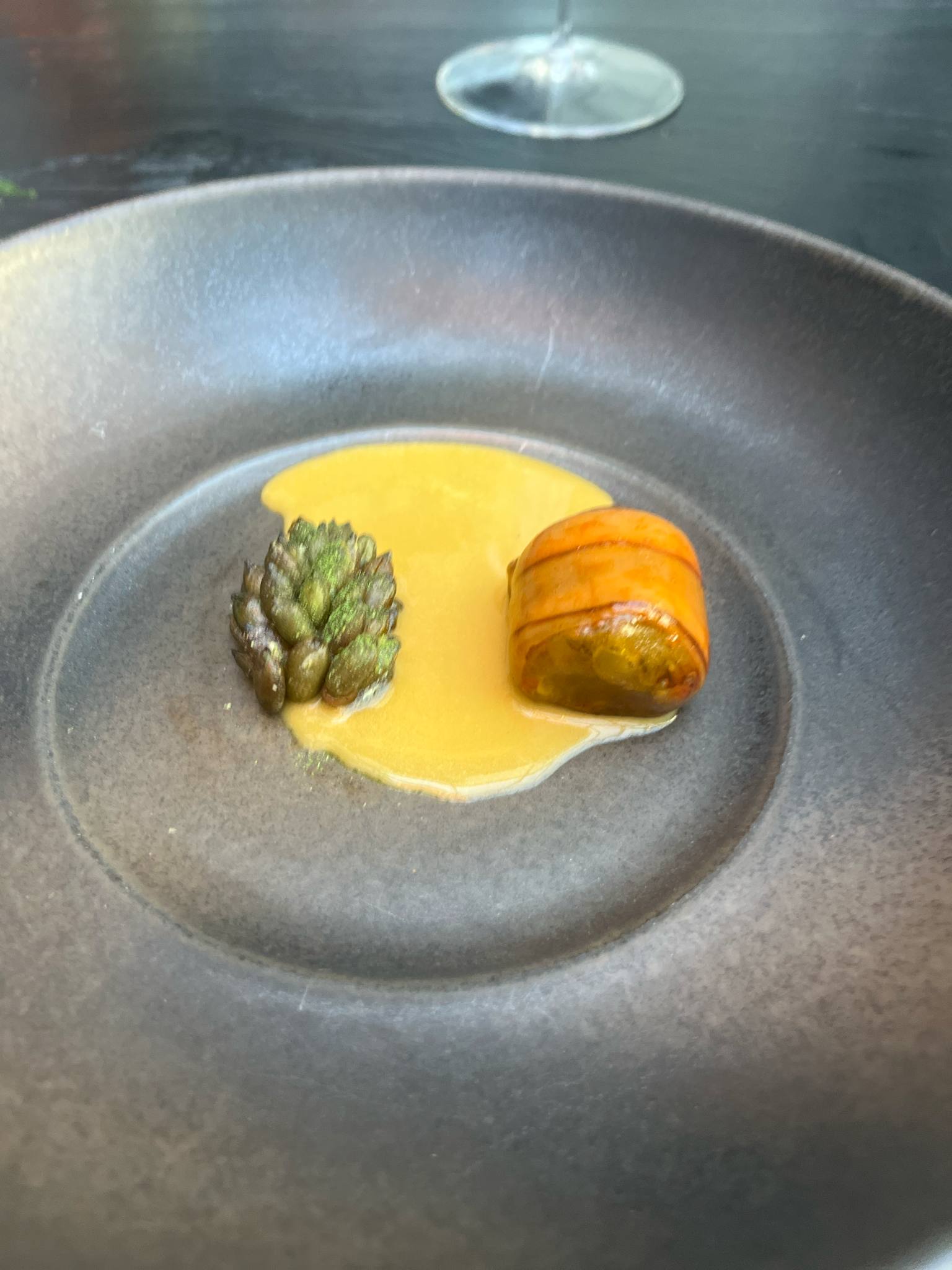
I really enjoyed the eggplant. It’s flavor was similar to an Indian roasted eggplant dish my mother makes. That specific dish is a little smoky and charred which, when combined with the natural “soil” like taste of eggplant, provides a very intricate bitterness. This is contrasted with the subdued sweetness of eggplant and also helps add textural variation between the more solid, charred exterior, and the soft, gooey interior. In this case, the dish traded in some of the char to focus more on showing off the sweetness of the eggplant. That said, the eggplant still had a wonderful smokiness. The eggplant coalesced with the hazelnut puree and combined its soil accented sweetness with the puree’s nuttiness. The puree was sweet as well but was more punctuated by its particular nuttiness that felt like it carried the “flavors” of forest trees that are a little deeper, hearty, dusty, and less toasted than more classic nutty flavors like sesame. Both these hearty elements were well complimented by the citric acidity of the passion fruit sauce, which was more tart than sweet. However, most importantly, it added a heavy dose of brightness to a very deep, developed base. It was certainly not as exciting as the last few dishes, but it was a great interchapter so to speak.
At the beginning of the meal, when you see the menu, you are shown 6 other dishes from previous menus from the restaurant that you are allowed to order. I am not a big fan of tasting menus having add ons (with the exception of caviar and truffle which are just accoutrements) because I’d like to believe I’m being served the best version of the menu. But since I didn’t know the next time, if ever, that I’d be able to return, I decided I’d get all the add ons. That request was quickly met by shock and a little amusement. Evidently, 1 add on is a decent amount of food, and 2 would mean you’re rolling out of the restaurant by the end. I decided I’d happily tumble out of the restaurant from being stuffed based on the caliber of dishes to that point so I chose 2 dishes. I will say, I appreciate that this is not the generic approach to menu add-ons and is rather truly the restaurant wanting to give you the option to have some of the highlights from their past. From my research, the marigold caviar dish is one of the most popular, but for me, it seemed a little less exciting, primarily just being a very beautiful presentation of a mound of caviar. So I opted for two others.
10. Veal Sweatbreads with a Peanut Based Sauce, Shrimp Tails, some Pineapple, and a Foam made from the Shrimp Heads
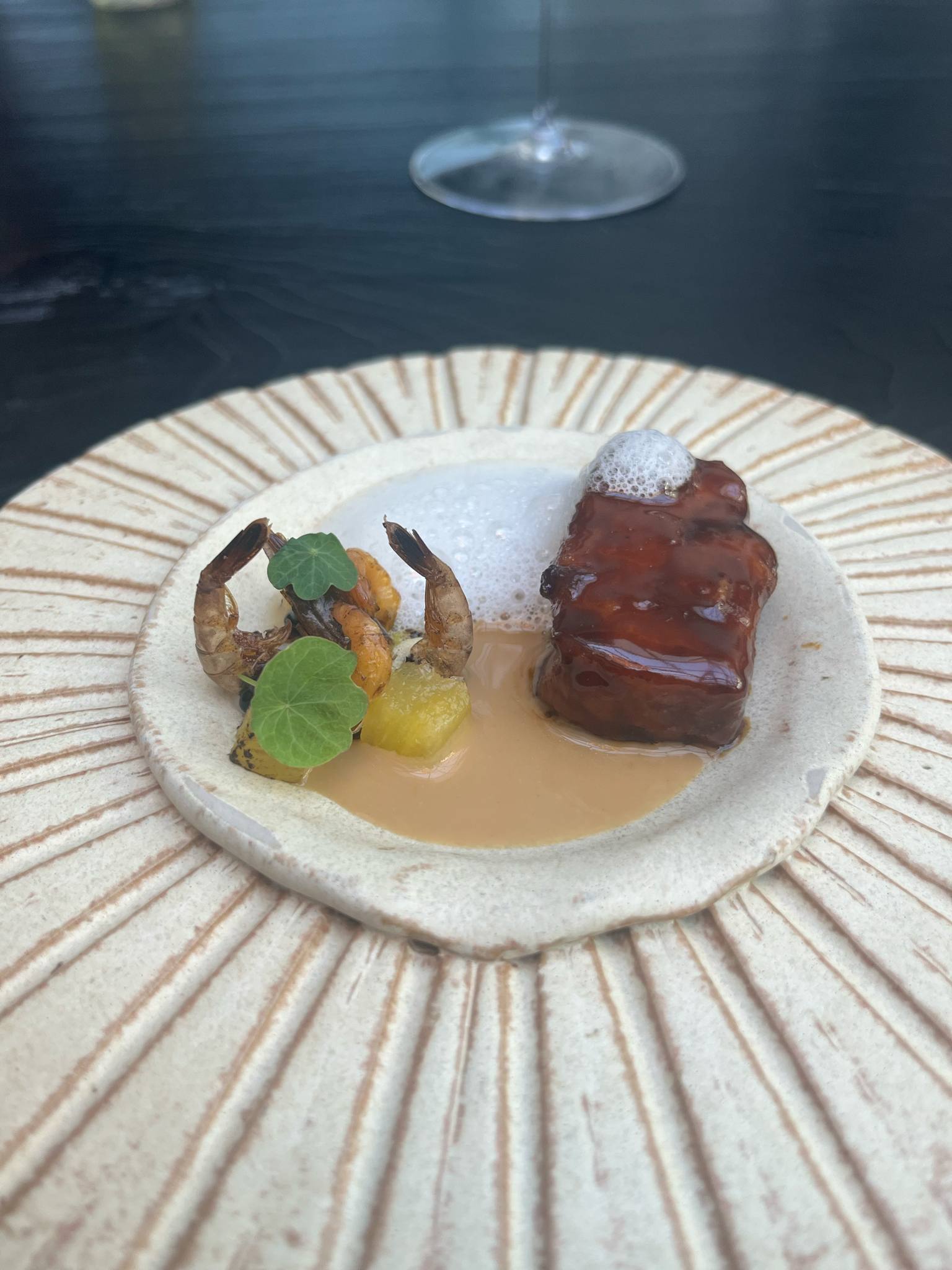
This was the first of my additional choices and was one of the absolute highlights of the already amazing meal. I’ll note that the pineapple felt a little irrelevant, and the foam was nice but not super flavorful in the face of all the other bold elements. However, the peanut sauce was otherworldly. It was of course nutty, but also was velvety in texture and tasted creamy with just the perfect touch of sweetness. It was very 50-50 between sweet and salty which is exactly what you’d want from a peanut butter and that goes doubly so for its saucy analogue. What was especially amazing was how well it mixed with the sweetbreads. It’s rare to have any meat combined with any sauce so well that neither flavor overpowers the other. In this case, that roasted, sweet and salty peanut sauce married the soft and meaty, caramelized sweetbreads. The sweetbreads themselves were pillowy, a little creamy, and marked by a subtle sweetness that I can best describe as the red meat equivalent of a shrimp’s sweetness. Just the same, because it was still red meat, it packed a heavy, dark umami punch. As I ate it, I was first hit with the caramelized exterior of the sweetbreads that was almost candied, followed by the true harmony of the creamy, sweet, and umami forward sweetbreads and the creamy, sweet, and salty peanut sauce. The shrimp tails further elevated this dish by adding an amazing mineraly and salty crispy element to intersperse between bites of the sweetbreads. Unlike some of the earlier dishes that were about distinguishing particular flavors of the constituents using either contrasting or complimentary flavors, this was a dish that used the underlying creamy and sweet properties of its sauce and meat to create a homogenized, original flavor. Without a doubt the best sweetbreads I’ve had in my life. Though since it is indeed just a perfect execution of a special meat with a creative sauce, it is less mind blowing than both the vanilla langoustine dish and the foie gras and shrimp plate.
11. Roe deer, Black Pudding Sauce, and a Cabbage Sauce
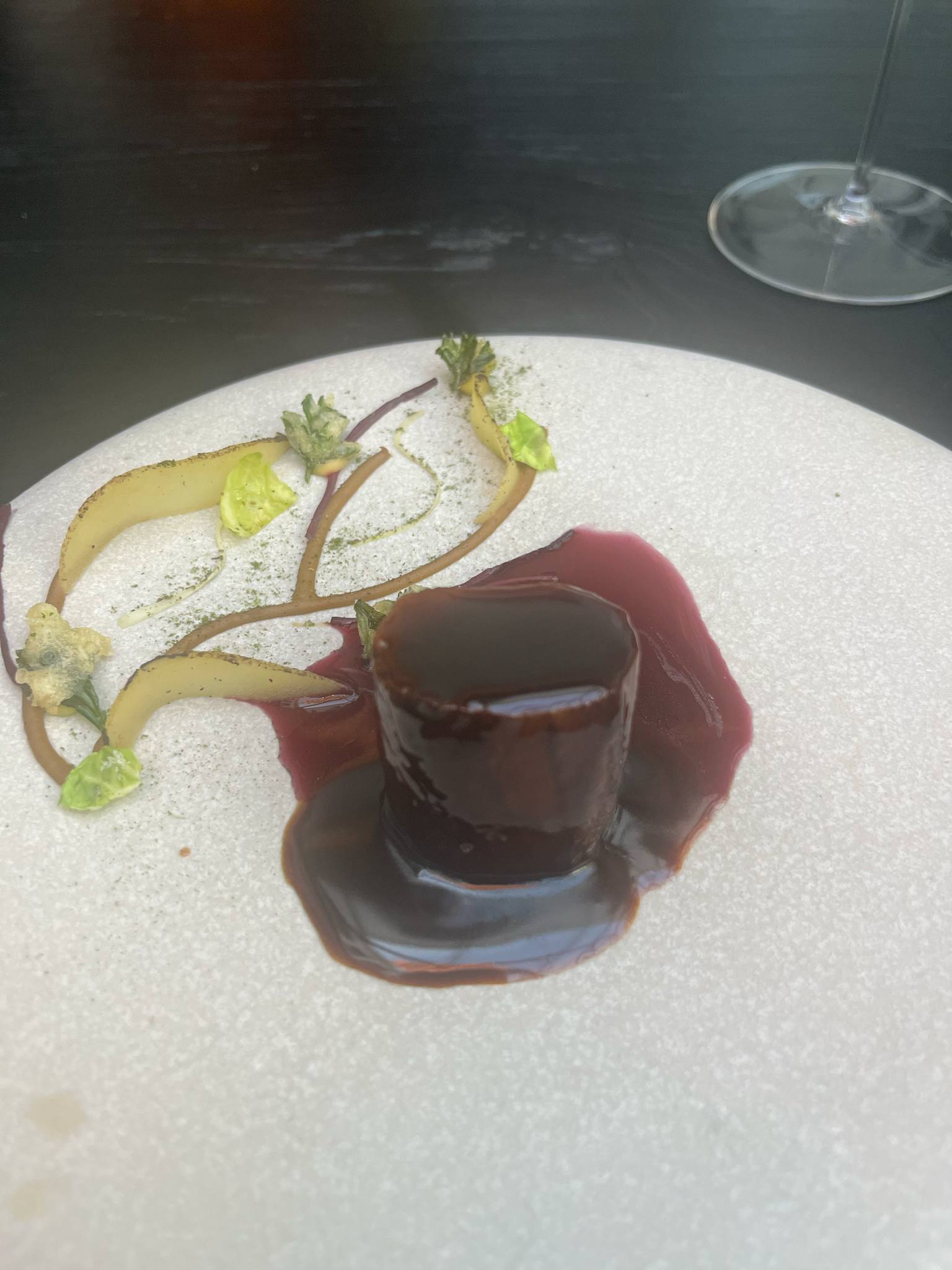
In between my first and second add ons, we were given our final main that everyone was served. This was a medallion of the roe deer with a sauce made from cabbage and the roe jus, and also a small amount of a sauce made from pureeing black pudding. Unsurprisingly there was heavy umami in the lean roe which had an outstanding chew. What was cool was there was a little of a sausage kind of flavor because of the low fat content of the roe mixed with its innate gaminess. That sausage flavor is far more exciting to me than the generic steak in red sauce flavor that abounds in most of these tasting menus. The roe’s gaminess itself would be most analogous to a more subtle mineral/copper flavor you’d usually get from blood sausage. The sauce itself was great because it was sweet like a vegetal molasses and actually coated the meat. The sauce was given a true chance to shine because Sausage-like flavors lend themselves to combinations with sauces much more since they aren’t pure hits of savory meatiness and fat. Overall, this was a great dish, but I do think it’s a slightly worse version of this dish than another place I love (Aska). That’s a very high standard for this dish though, so it’s not surprising it fell just short of it.
12. Epoisses Balls, Rabbit Kidney, Chorizo, and a Potato Puff in an Epoisses Sauce
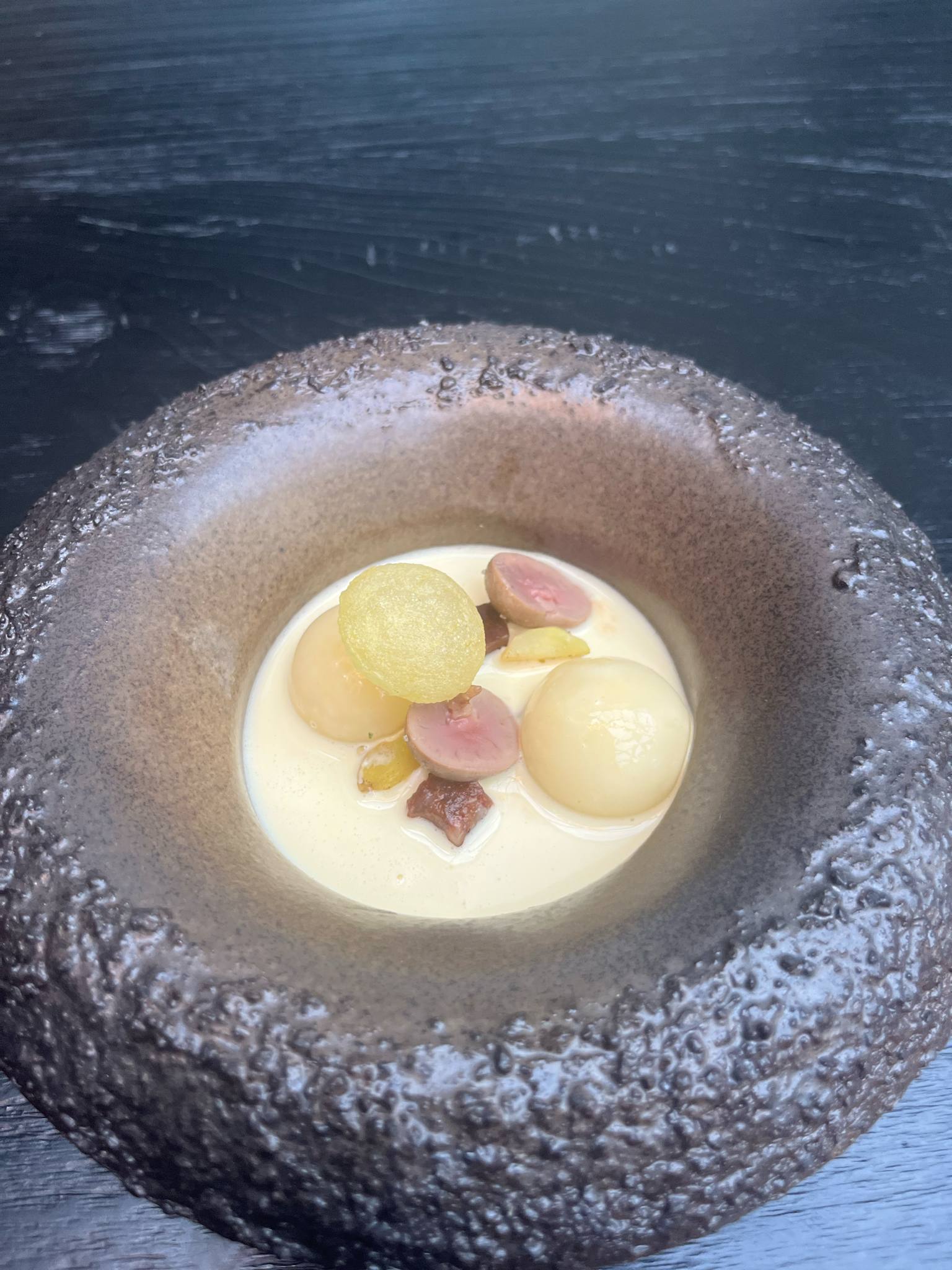
This was my final add on dish. For those who don’t know, epoisses is a very soft, washed rind cheese from Burgundy. It is an extremely stinky and funky cheese that happens to be one of my favorite cheeses of all time. Unfortunately, it’s quite tough to buy, not because of scarcity but because if I have it, I have to have my apartment fumigated. Luckily this wasn’t my apartment, so this was the perfect final dish for me to choose. On the plate were 2 balls which were essentially an exterior made of epoisse that had the texture of pasta enclosing melted epoisses. Along those were some cuts of rabbit kidney, some chunks of chorizo, and an airy potato puff, and all of this was bathed in an epoisse cream sauce. This was, without a doubt, one of the best dishes of the meal, and of my life. I was instructed to eat each epoisses ball in its entirety. I followed those instructions and proceeded to consume the best mac and cheese I’ve ever had. I have no idea how they made the exterior from the soft cheese but it was a brilliant decision because the pasta like exterior maintained the mushroomy and earthy flavors of the cheese while the melted interior stressed the fatty, creamy, and cultured buttery elements of the cheese. It was cool to eat something that split these flavors into two components and then combined them. It was like discovering epoisses for the first time. As for the other components, the potato puff was airy, crispy, and a fun potato chip addition to the dish. It wasn’t necessary but it was certainly appreciated. The chorizo was savory, concentrated, complex, and fatty with just a little bit of that piquant burst that helped cut some of the buttery and funky elements of the dish. The chorizo is so vital because most other ingredients would just be erased by the intensity of the cheese. The kidney was even better because it still maintained the earthy, barn-yard evoking tenor of the dish and in fact added a gamey and meaty analogue that assisted in rounding those unique characters of the dish. Overall, the dish was a waltz of demanding flavors including mineral, metallic, mushroomy, savory, meaty, salty, peppery, and gamey all set to the melody of epoisse.
This was the final course, and then we had dessert
13. Dark Chocolate on Pan-Fried and Deglazed Crawfish with Rum
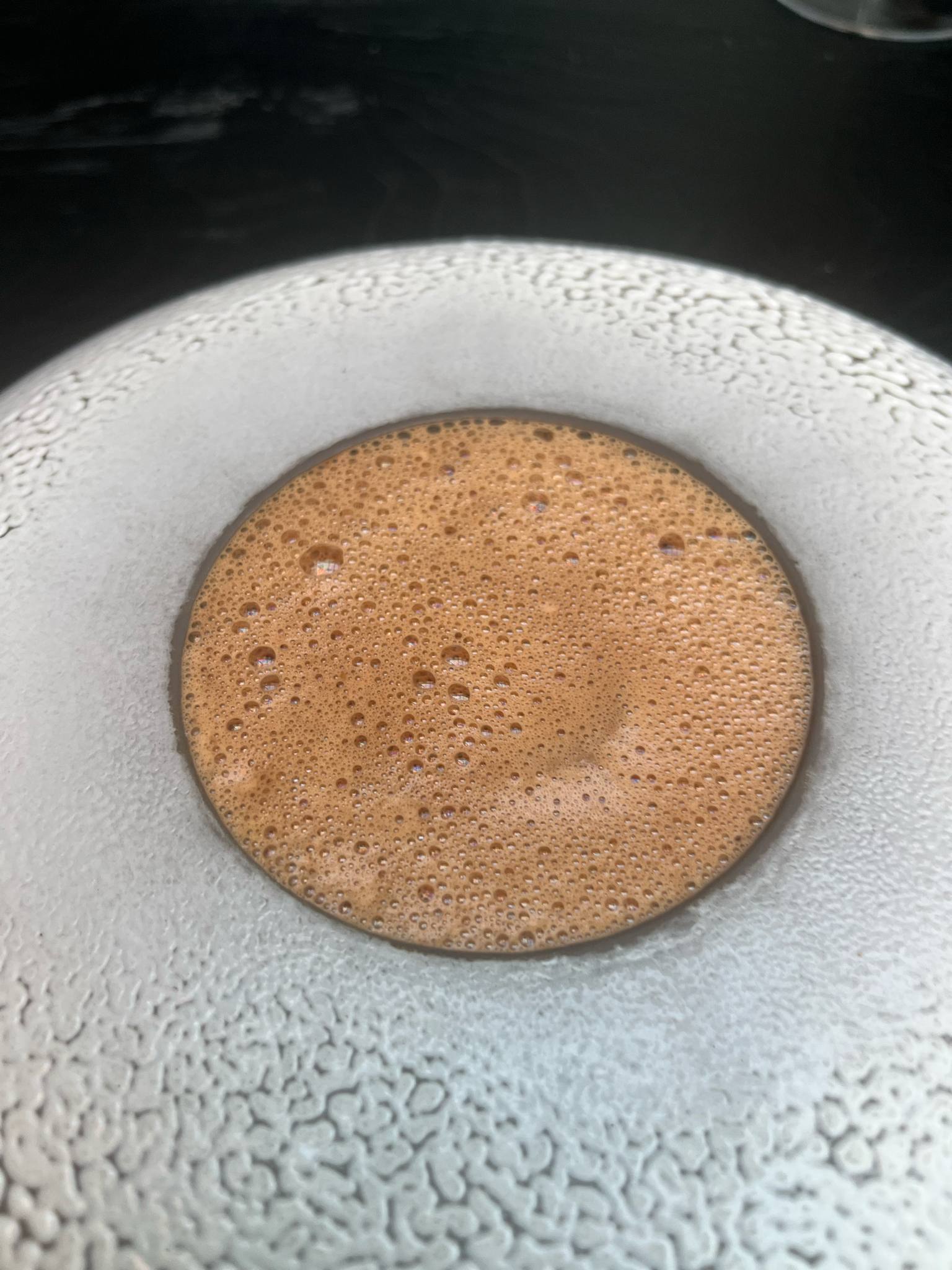
This was the first of 4 small desserts. This is the exact type of dessert I love. I tend to find most desserts just go into one note sweetness, or are primarily chocolate which just happens to be something I don’t adore enough to eat a full plate of. However, in this case, there was a very intriguing flavor coming from the concentrated, shrimpy salinity from the crawfish mixing with the bittersweet chocolate. The mixture’s success was certainly a surprise to me, but it tasted like a match made in heaven when the two components did coalesce. It was similar to some of those artistinal chocolates that mix salt or spices with dark chocolate (like Vosgues-Haute Chocolate). Essentially that salinity and roasted shrimp flavor cuts the bitterness of the dark chocolate but not by overpowering it with a cloying syrup or ice cream. Instead it just sort of takes the bitterness from the chocolate and combines it with the intensely flavored crawfish leaving the more creamy, rich, and sweet elements of the chocolate to be appreciated on their own. The only issue is there were only a couple bites where there were literal crawfish to mix with the chocolate foam/sauce.
14. Trio of Small Desserts
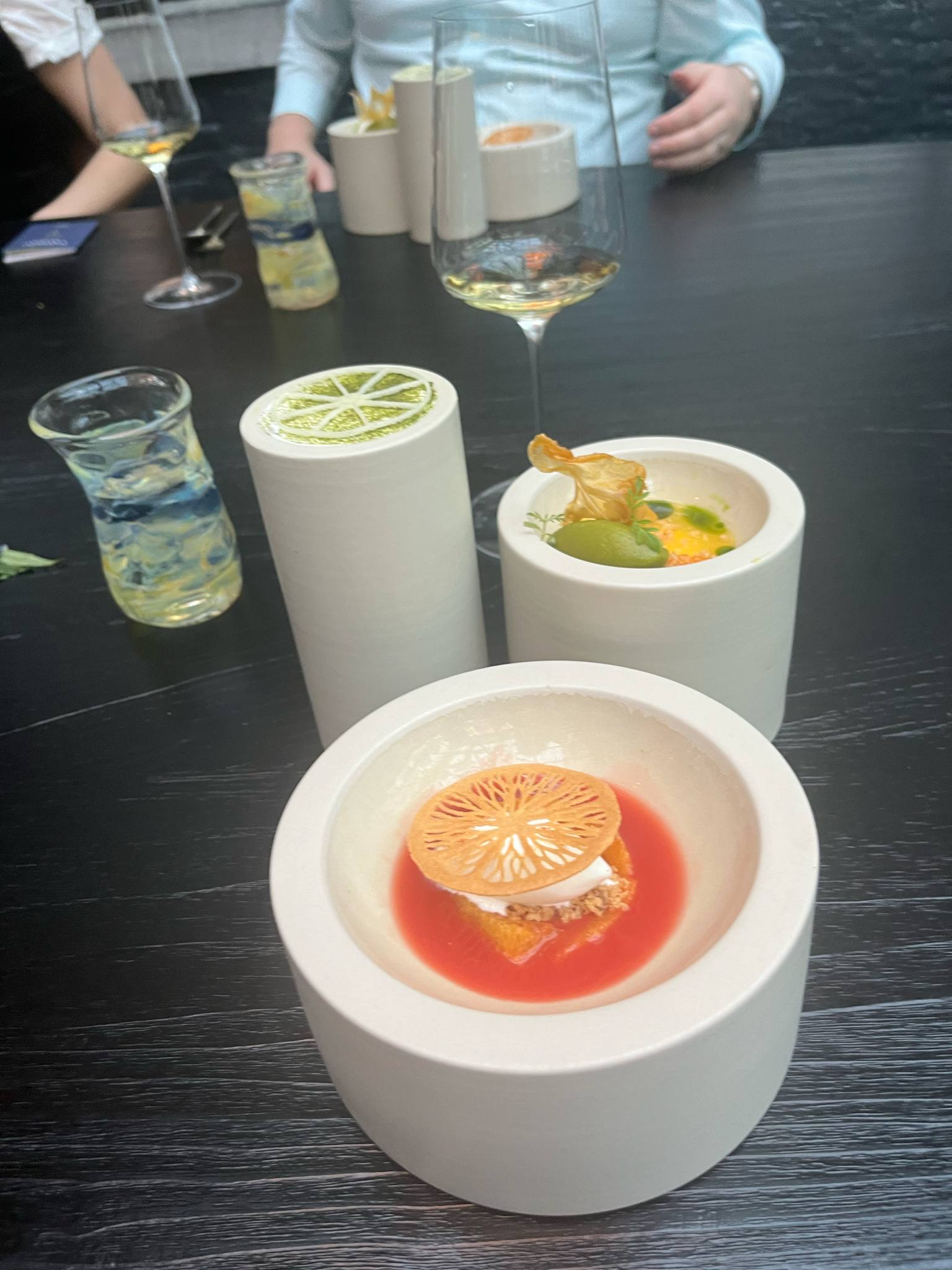
The final dessert was a collection of 3 small desserts before the petit-fours
Coconut and Galangal Powder on an Ice Cream-
I believe the ice cream was vanilla. This was delicious especially because of the astringent kick from the galangal powder that helped cut the sweet ice cream. The coconut and galangal made this feel like a thai curry inspired ice cream which was awesome.
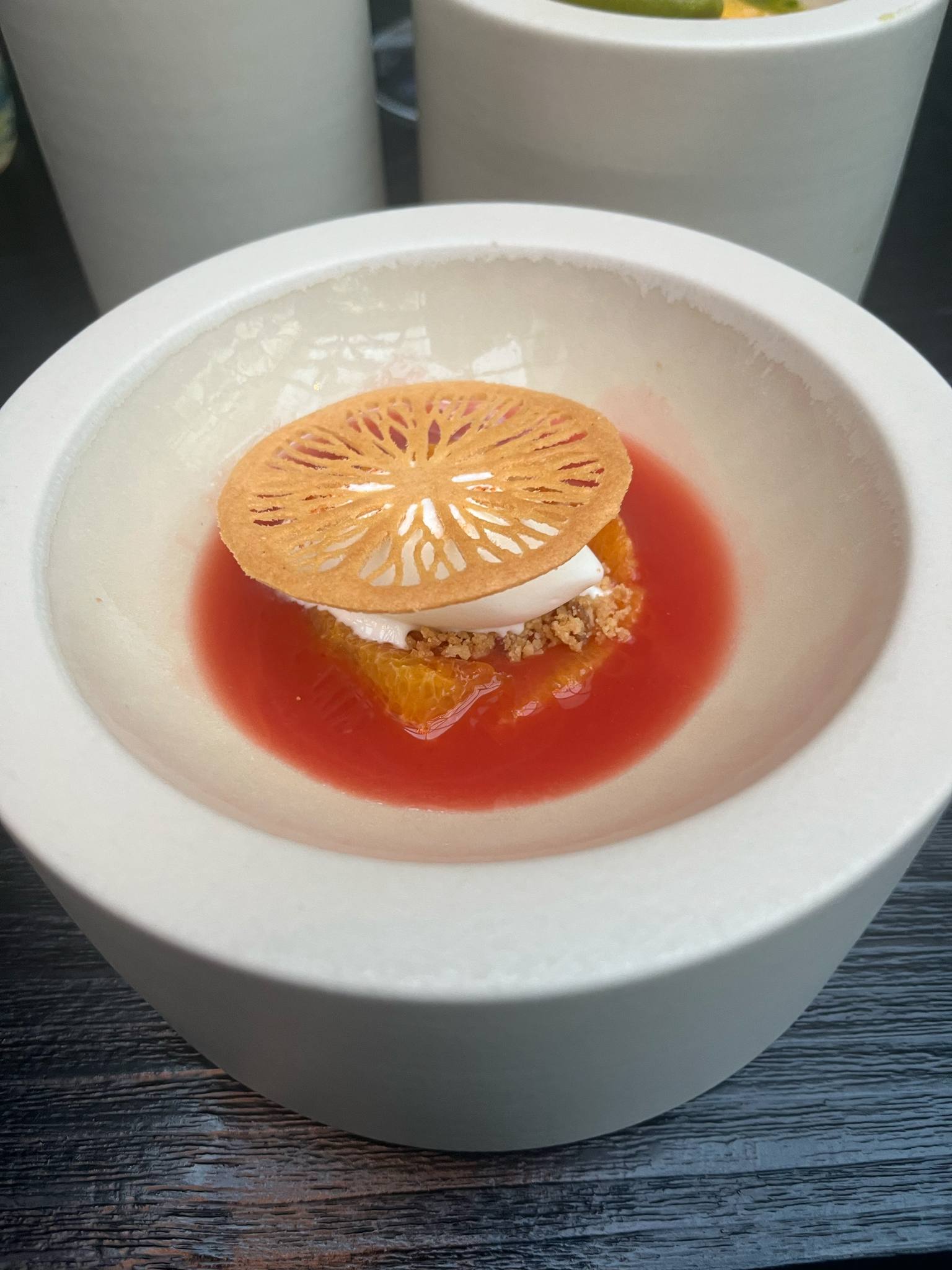
Blood orange, Rosemary, and Fried Dough in a Rosemary and Orange Cream
This was the most basic of the 3. It was tasty and fresh. The citric acid mixed with cream is always a great combination and the blood oranges were very tasty. I do wish the rosemary came through more though.
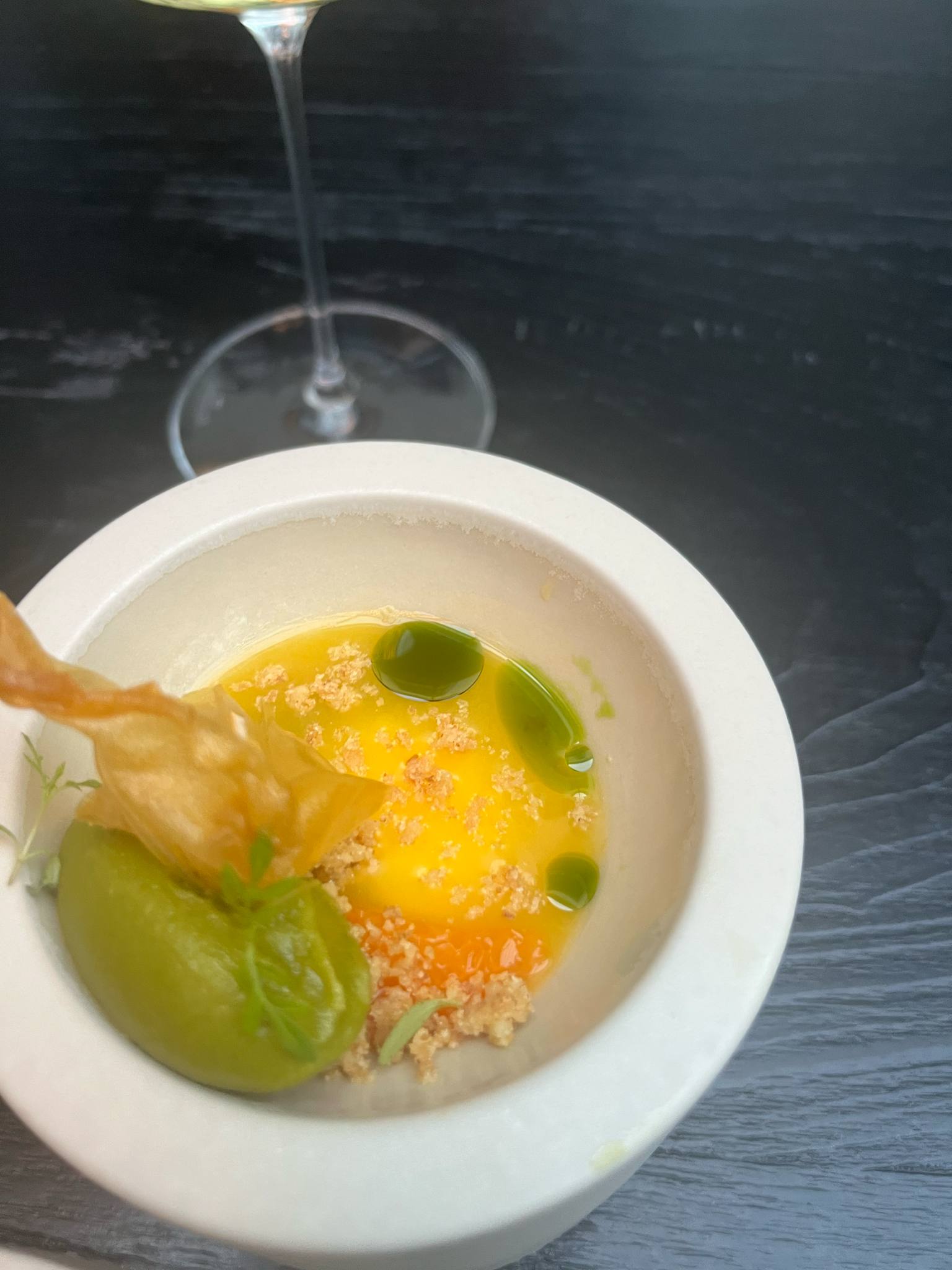
Dill Ice Cream with Dill Oil
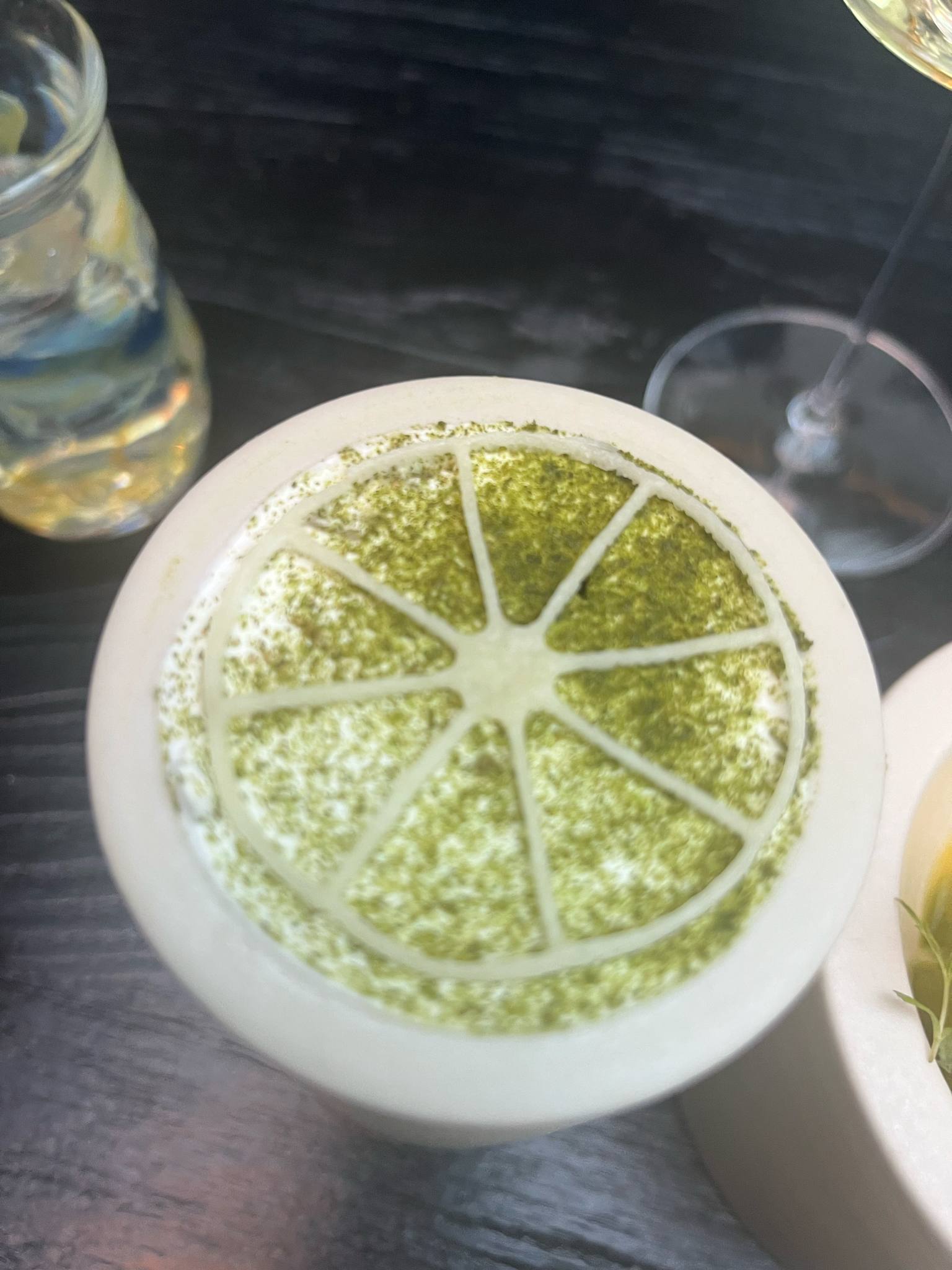
This was one of my favorite desserts of all time. Dill is something so herbaceous and associated with savory items, that I was surprised they were able to integrate it properly into a sweet item. It was indeed very dill forward but the main flavor was vanilla ice cream with the dill dominating the aroma and enveloping the flavor as opposed to penetrating into it which helped keep it as a proper dessert. The actual pairing was cool for the same reason so many of these dishes were, because it allowed me to think about ice cream, and more importantly dill in a unique way and specifically appreciate the more herbaceous and minty elements of dill as opposed to its usual deployment as a savory accent.
Final Thoughts
As noted, at the beginning and throughout my account, I loved this meal. At worst, it’s the third best meal of my life. It has me writing obnoxious purple prose to the moon and back because of its capability of combining delectable flavors, innovative pairings, and artistic imagining which my self-indulgence can’t quite articulate. What’s interesting is unlike something like Disfrutar, or Atomix, or even Le Pre Catalan, it’s tough to discern at the outset, what the “aesthetic intention” of the meal is. Not necessarily the Chef’s personal intention but the meal’s internal argument so to speak. However, the meal feels affecting during, immediately following, and for a long time afterwards. From my perspective, some characteristics of its aesthetic scope include a capacity to create dishes from bold and overwhelming ingredients but maintain their individual integrity, as well as dishes from more delicate flavors while supercharging their perhaps more ephemeral flavors. It includes using Dutch ingredients in ways generally unencountered to reveal the depth of an oft forgotten country with respect to cuisine. It includes taking the diner through stages of each dish, letting flavors develop in a precise sequence to not just make each plate a collection of delicious bites, but a progression of tasty vignettes. It’s tough for me to coalesce these into a crystallized thesis. However, if you’ll humor one last pretentious remark, I’d say De Librije commits to an apotheotic expression of Dutch ingredients that lets the diner feel for a moment that they have discovered an aesthetic grammar for a comprehensive and refined picture of the flavors of each ingredient. De Librije, from combinations of funky and intense ingredients (epoisse balls) to ballets of diaphanous ingredients (vanilla and langoustine) engenders a discovery of nuance otherwise reserved for the cognoscenti, the brotherhood of chefs and critics. It brought even someone like me a moment to enact the role of a connoisseur and for that, it cemented itself as one of the best meals in the world.